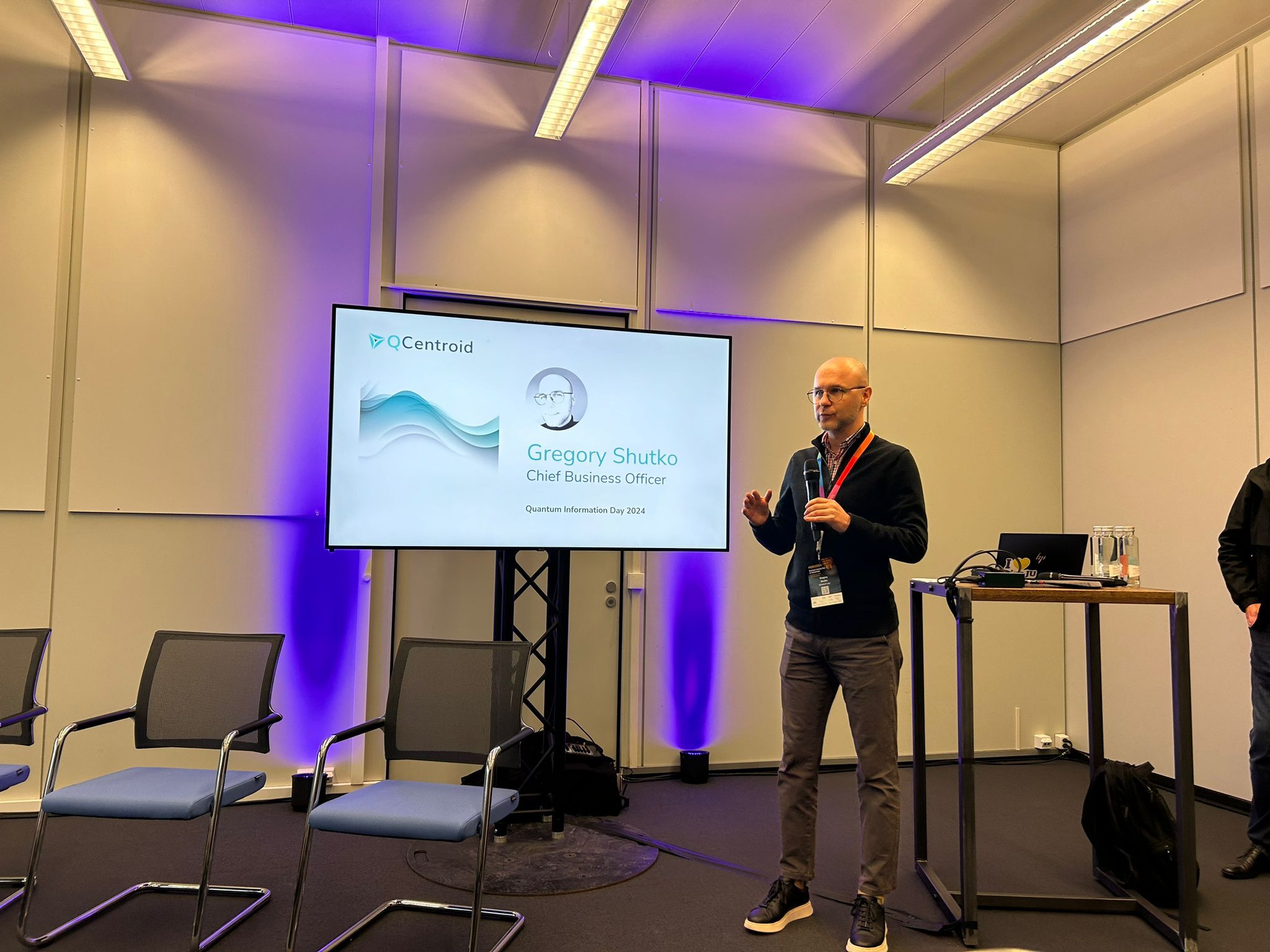
QCentroid at the Heart of Quantum Innovation at Swiss Quantum Industry Day

Gregory Shutko CBO QCentroid
  • Gregory Shutko, QCentroid’s Chief Business Officer, participated in a panel discussion on business development at the Quantum Industry Day 2024.
  • The event fostered collaboration among key players in the Swiss quantum industry and emphasized the transition from research to real-world applications.
  • QCentroid is committed to simplifying and de-risking the adoption of next-generation computing, making quantum technologies accessible to all.
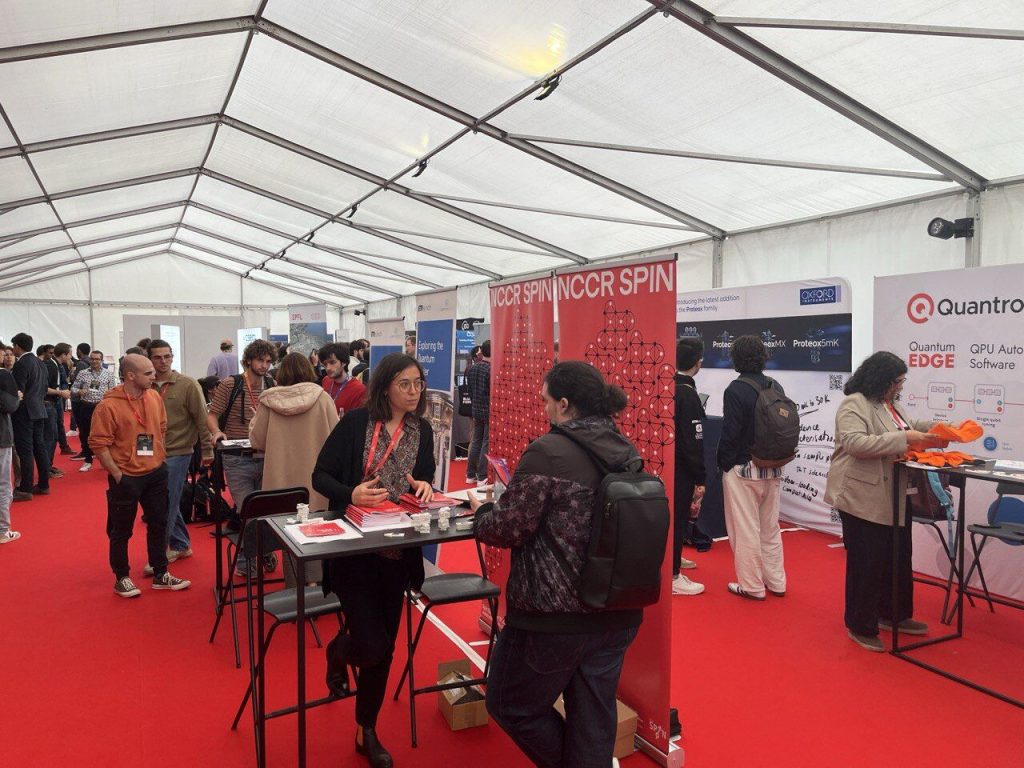
What is the Quantum Industry Day and Why It Matters

Organized by a collaboration of leading organizations, including IDQ, IBM Research, and NCCR Spin, the Quantum Industry Day is the premier event for the Swiss quantum industry. Held on September 23, 2024, this year’s edition drew over 400 attendees from academia, industry, and government, all focused on advancing quantum computing, communication, sensing, and security. The event’s timing, just ahead of the United Nations’ International Year of Quantum Science and Technology 2025, highlighted the increasing global importance of this field and its potential to revolutionize various industries. The event offered exclusive networking opportunities with top quantum experts and industry pioneers, fostering collaboration and career development. Companies showcased their products and research to a diverse audience, while attendees gained insights from thought leaders through keynotes and panels addressing key industry challenges and opportunities.
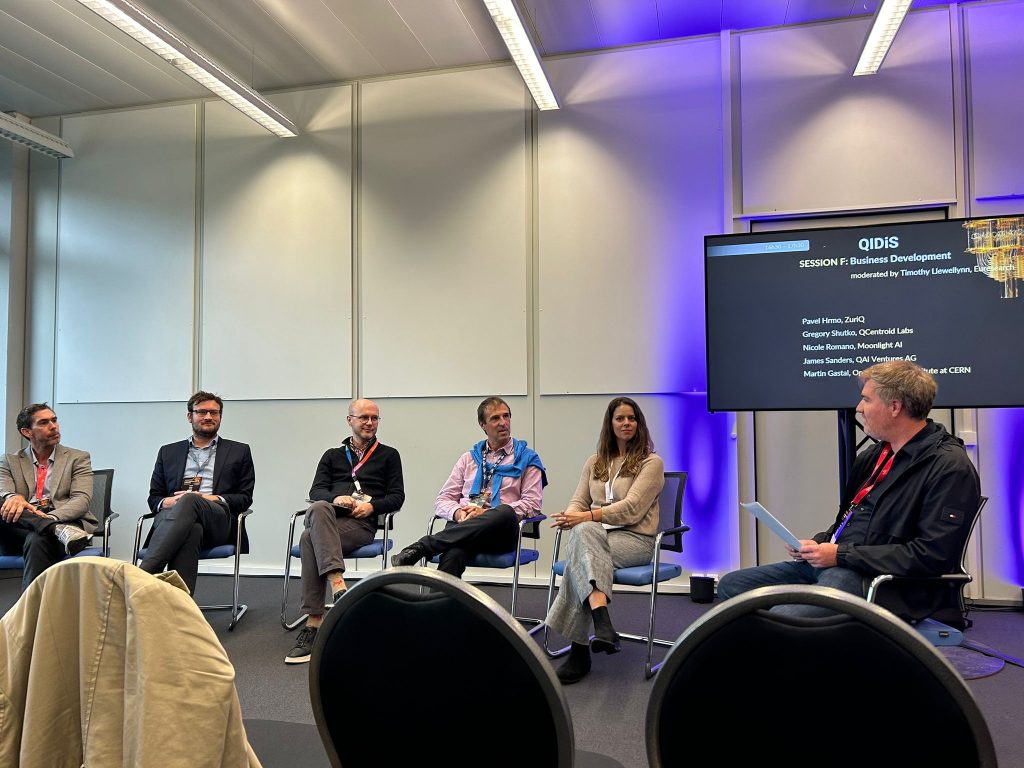
QCentroid at the QDIS 2024

Gregory Shutko, our Chief Business Officer, joined a panel of experts to discuss quantum adoption and industry development in Switzerland and the EU. Alongside Pavel Hrmo of ZuriQ, Nicole Romano of MoonlightAI, James Sanders of QAI Ventures, and Martin Gastal of the Open Quantum Initiative, and moderated by Timothy Llewellynn of Euresearch, the session delved into the journey from quantum research to market success.

During his introduction, Gregory shared his professional journey into the quantum field and highlighted QCentroid’s mission to simplify and de-risk the adoption of next-generation computing. He explained that QCentroid’s motivation stems from the recognition that quantum computing, while powerful, is often inaccessible due to its complexity.

The panel addressed several crucial questions, including how to prioritize applications, navigate funding challenges, and foster collaboration within the quantum ecosystem. They also discussed the potential of quantum computing to tackle global challenges aligned with the UN’s Sustainable Development Goals.

Key Insights from the Discussion

  • Focus on Practical Applications: The panel emphasized the need to identify and develop quantum applications that address real-world problems, balancing short-term market needs with long-term potential. Market demand, technological feasibility, and positive societal impact should be at the heart of decision-making.
  • Strategic Funding Approaches: Quantum startups face unique funding hurdles. The discussion highlighted effective strategies for securing investment, including demonstrating clear paths to ROI and leveraging a blend of private and public funding sources.
  • Interplay Across the Quantum Stack: The integration of quantum hardware, software, and applications is crucial, similar to how Microsoft and Intel collaborated on the PC. The panelists explored how their respective companies contribute to this integration and the importance of collaboration across these layers.
  • Leveraging Lessons from Other Deep-Tech Sectors: The panel acknowledged the value of learning from other deep-tech sectors like AI, biotech, and nanotechnology. Adopting best practices and models from these fields can accelerate the development and commercialization of quantum technologies.
  • Switzerland’s Role in the Global Quantum Landscape: The discussion touched upon Switzerland’s strengths as a quantum hub, including its strong research institutions and supportive ecosystem. The panelists considered how Switzerland can maintain its competitive edge in this global race.
  • The Maturing Quantum Market: Quantum Industry Day showcased the growing momentum behind quantum technologies, with a clear emphasis on practical applications and the transition to commercial viability.
  • Collaboration is Essential: The event underscored that a collaborative ecosystem – uniting researchers, startups, established companies, and investors – is vital for accelerating progress in the quantum field.

Looking Ahead

QCentroid is committed to driving the adoption of quantum technologies. We’re excited to continue building relationships and collaborations within the quantum community, working to make the power of next-generation computing accessible to all.

Take the Next Step

Ready to explore how QCentroid can help your organization navigate the quantum revolution? Contact us today to discuss how we can partner with you on your journey to next-generation computing.

Follow us on LinkedIn to stay updated on our progress and the latest developments in the quantum field.
QCentroid and QPerfect Partner to Accelerate Enterprise Quantum Computing

Strasbourg, 19 September – QCentroid, the pioneering Quantum-as-a-Service platform provider, and QPerfect, a leading European deep-tech company specializing in quantum computing solutions, today announced a partnership to make quantum computing more accessible and practical for businesses.

This collaboration combines QCentroid’s powerful Quantum Ops platform with QPerfect’s unique virtual quantum computer, MIMIQ 1.0, to deliver an unparalleled quantum experience to enterprises. By integrating MIMIQ’s capabilities into the QCentroid platform, businesses can now seamlessly access, test, customize, benchmark, and deploy quantum applications at an unprecedented scale.

Bridging the Quantum Gap

Many organizations are eager to explore quantum computing’s potential but face barriers like cost and complexity. This partnership addresses these challenges by combining QPerfect’s advanced MIMIQ virtual quantum computer with QCentroid’s enterprise-focused QuantumOps platform.

MIMIQ: Next-Gen Quantum Simulation

MIMIQ allows businesses to design, test, and optimize large-scale quantum algorithms, effectively simulating the power of future quantum computers today. This empowers organizations to benchmark for quantum advantage and prepare for the upcoming fault-tolerant quantum computing (FTQC) revolution.

QCentroid: Simplifying Quantum for the Enterprise

QCentroid’s QuantumOps platform provides rapid access to quantum experimentation, enterprise-grade security, and seamless integration with existing IT infrastructure. Together with MIMIQ, it creates a unified ecosystem for businesses to explore quantum solutions efficiently and securely.

Partnership Benefits

  • Immediate access to MIMIQ next-gen quantum capabilities on the QuantumOps platform.
  • Curated catalog of pre-built, MIMIQ-powered use cases.
  • Seamless enterprise deployment of quantum solutions.
  • Accelerated learning curve for businesses across industries.

Why It Matters

This partnership significantly lowers the barriers to quantum computing adoption, enabling businesses to:

  • Reduce time-to-value for quantum initiatives
  • Minimize technology risk through large-scale experimentation
  • Gain a competitive edge by preparing for the quantum computing future

Executive Perspectives

Philippe Blot, CEO of QPerfect, commented on the partnership, “This collaboration with QCentroid is a key milestone in making quantum computing practical and accessible to businesses. By integrating our MIMIQ technology into their QuantumOps platform, we’re empowering enterprises to experiment and innovate with quantum algorithms at an unprecedented scale, accelerating their path to quantum advantage and the future of fault-tolerant quantum computing.”

Carlos Kuchkovsky, CEO and co-founder of QCentroid, added, “The integration of QPerfect’s MIMIQ technology with our QuantumOps platform represents a significant step forward in enterprise quantum computing. This partnership enables businesses to bypass many of the current limitations in quantum hardware, allowing them to experiment with large-scale quantum algorithms today. By providing this capability, we’re helping organizations build quantum readiness, optimize their processes, and gain a competitive edge in preparation for the era of fault-tolerant quantum computing.”

Looking Ahead

In the coming months, QCentroid and QPerfect will further integrate their technologies, offering a unified platform that seamlessly blends MIMIQ’s capabilities with QCentroid’s Quantum Ops features. This integration will enable businesses to leverage the full power of quantum computing, from experimentation to production deployment.

Contact: 

Gregory Shutko, gregory@qcentroid.xyz

Georges Le Nigen, georges.lenigen@qperfect.io 

About QCentroid

QCentroid is a leading next-generation computing platform provider. It empowers businesses to use the best computational approaches for a given problem, optimizing business efficiency and net zero goals at the same time. When it comes to quantum computing, the QCentroid platform offers the first-of-its-kind Quantum Ops features to streamline the entire quantum application lifecycle, enabling businesses to focus on innovation and value creation. By hiding the quantum complexity and empowering users with intuitive AI tools and clear workflows, QCentroid transforms how quantum experimentation is done, from months to weeks, enabling companies to get to utility and their net zero objectives faster. 

Ready to explore advanced computing opportunities today and future-proof your business for tomorrow? Schedule a demo today, and follow us on LinkedIn

About QPerfect

QPerfect, a pioneering quantum computing start-up based in France, is driving advancements that accelerate the development of fault-tolerant quantum computing. The company is at the forefront of designing, simulating, and optimizing quantum computers through its innovative hardware and software solutions. QPerfect’s virtual quantum computer, MIMIQ, is revolutionizing the field by enabling large-scale simulations of quantum computing systems. Capable of executing quantum algorithms on up to thousands of physical qubits, MIMIQ sets a new benchmark in the industry. Building upon MIMIQ, and with a specific focus on neutral atom quantum computers, QPerfect is developing comprehensive software and hardware solutions. These solutions aim to provide end users with quantum computing services and propel quantum computers towards fault-tolerance.

Explore how QPerfect is leading us towards the revolution of fault-tolerant quantum computing at www.qperfect.io and follow us on LinkedIn.

Kipu Quantum and QCentroid Partner to Drive Quantum Computing from Bizkaia to Spain and the World

Bilbao, 12th September 2024  — Kipu Quantum, the leading developer of novel hardware- and application-specific quantum computing algorithms, and QCentroid, a leading Quantum-as-a-Service (QaaS) provider, are pleased to announce their strategic partnership to advance quantum computing projects from Bizkaia to Spain, Latin America, and beyond. 

Quantum computing is poised to revolutionize industries by solving complex challenges in logistics, telecommunications, healthcare, artificial intelligence, finance, and more. Spain’s quantum market has seen significant growth in recent years, driven by a mix of public and private initiatives that position the country as a key player in the quantum technology race. Among all of them the Bizkaia quantum ecosystem shines with its own light. 

The disruptive quantum computing algorithms pioneered by Enrique Solano and his team at Kipu Quantum represent a new frontier in smart encoding and the maximal acceleration of digital, analog, and hybrid approaches for industry-specific use cases. 

This partnership between Kipu Quantum and QCentroid leverages the unique strengths of both companies to introduce quantum computing through practical implementations of industry use cases, accelerating Bizkaia and Spain’s journey into the commercial quantum era. 

“We are thrilled to partner with Kipu Quantum and bring their groundbreaking quantum solutions to our customers and partners,” said Carlos Kuchkovsky, CEO of QCentroid. “By combining our expertise, we are set to deliver quantum computing projects that will bring tangible value to the worldwide stakeholders” 

“Our collaboration with QCentroid opens the door for Bizkaia and Spain to harness the power of quantum computing today,” said Enrique Solano, co-CEO and co-Founder of Kipu Quantum. “With our efficient algorithms, we are significantly reducing the time to reach useful quantum computing applications, paving the way for commercialization across diverse industries in Spain”, said CEO Daniel Volz. 

Together, QCentroid and Kipu Quantum are committed to unlocking the potential of quantum computing, driving forward this revolutionary field, and empowering businesses to accelerate their digital transformation. 

QCentroid Contributes to Industry Priorities at Q-Expo 2024

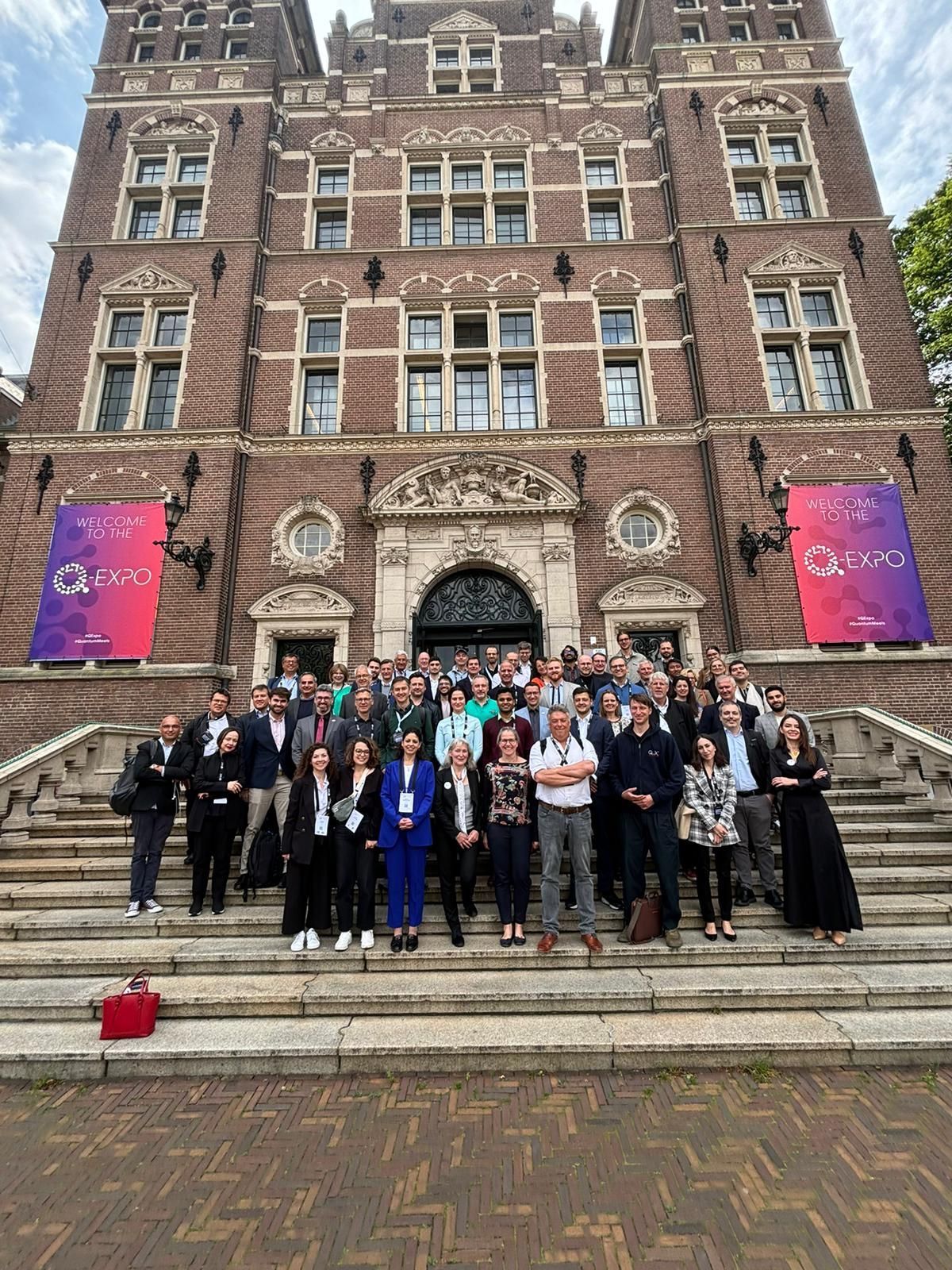
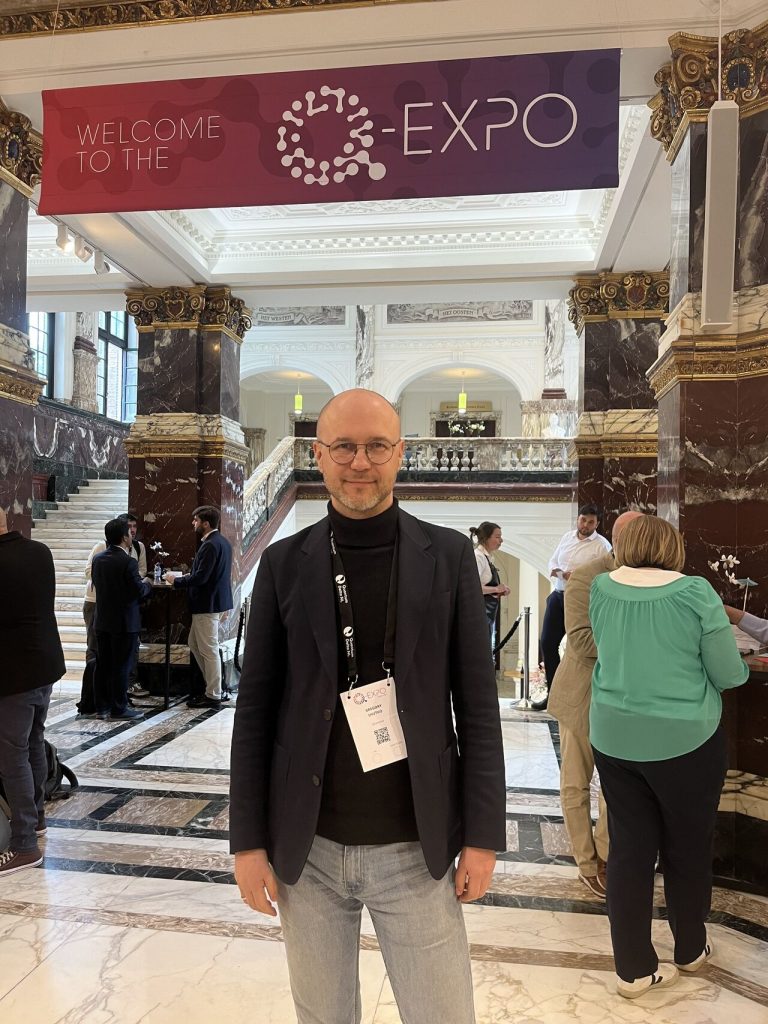
  • Gregory Shutko, QCentroid’s Chief Business Officer, participated in Q-Expo 2024, a premier European event for the quantum industry.
  • Gregory took part in the closed-door industry deliberations, contributing to defining the priorities for the industry for the coming year.
  • QCentroid, as a full member of the European Quantum Industry Consortium (QuIC), is a leading EU platform focused on quantum applications and ecosystem building to accelerate quantum adoption.
Gregory Shutko

What is Q-Expo and Why It Matters

Organized by QuIC and Quantum Delta NL, Q-Expo is a leading European event for the quantum technology industry. This year’s edition brought together key players from the quantum ecosystem, including researchers, startups, established companies, investors, and policymakers. Q-Expo provided a platform for showcasing the latest advancements, fostering collaborations, and discussing the future of quantum technologies. The event featured a mix of plenary sessions, technical presentations, and networking opportunities, creating a vibrant atmosphere for knowledge sharing and partnership building.

QCentroid at Q-Expo 2024

Gregory Shutko joined the discussions on the second day, including sessions with Olivier Ezratty, Roger McKinlay, Olivier Tonneau, and Anca Albu. And on the third day, Gregory helped to shape the future of the European quantum landscape by participating in closed-door industry discussions that defined QuIC’s priorities for the upcoming year. 

As a leader in QuIC’s working groups on quantum applications and ecosystem development, QCentroid, through Gregory’s contributions, shared valuable experience in identifying promising use cases, understanding customer needs, and fostering the growth of a strong quantum ecosystem.

Key Insights from the Event

  • Early Quantum Engagement: “Management by fear” remains a prevalent strategy for engaging customers in early-stage quantum adoption, often coupled with a focus on the “indirect” value of quantum technologies.
  • Energy Efficiency: Energy efficiency emerged as one of the six key industry challenges, highlighting the potential of quantum computing to optimize energy consumption.
  • Consolidation in the Industry: Experts predict an upcoming consolidation in both quantum software and hardware, potentially leading to a more streamlined and mature market.
  • Building Quantum Awareness: International organizations like the OECD are contributing to raising awareness of quantum technologies among policymakers.
  • Customer Focus: The industry needs customers, not just end users, emphasizing the need for feedback and co-development partnerships.
  • Funding Priorities: In the quantum sector, keeping costs under control and leveraging public funding are more critical than traditional metrics like IRR or user base.
  • Bridging the Language Gap: A gap exists between the technical language of the quantum industry and the business language of potential customers, requiring a translation to “what’s in it for me.”
  • Global Collaboration: Quantum industry associations like QED-C, Q-STAR, QIC, and QuIC are collaborating, signaling a need for a unified approach that transcends national boundaries and export controls.
  • Australia’s Bet: Informal discussions at the event centered around Australia’s (a G20 country) focused investment in a specific quantum technology, potentially leaving other parts of its domestic industry behind.
  • Merit-Based Cases: The second day of the event featured merit-based case studies from companies like Telefónica, Equinix, Port of Rotterdam, Deutsche Bahn, E.ON, Airbus, and ParTec AG.
  • Welcoming Event: Q-Expo provided a welcoming and warm environment, with ample opportunities for meetings, deep discussions, and building partnerships.

Looking Ahead

QCentroid remains committed to advancing the quantum ecosystem and driving the adoption of quantum technologies. We are dedicated to working with partners and customers to identify high-impact use cases and build a thriving quantum community. The QuIC is the main European quantum industry association, and for a pan-European quantum platform like QCentroid it is the right place to be to bridge the gap between the industry advances and the end users.

Are you interested in exploring how quantum technologies can benefit your organization? Contact us today to learn how QCentroid can help you navigate the quantum revolution and unlock the potential of next-generation computing.

Follow us on LinkedIn to stay informed about the latest developments in the quantum field and QCentroid’s contributions to this exciting industry.

QCentroid and OpenQuantum Partner to Democratise Access to Quantum Computing Solutions

Norwich, United Kingdom – 15 May – QCentroid, a leading Quantum-as-a-Service company, and OpenQuantum, a pioneer in open-source quantum computing hardware and software solutions, today announced a strategic partnership to make quantum computing more accessible, affordable, and faster to develop applications for.

This collaboration seeks to break down the barriers to entry that have traditionally hindered the progress needed for widespread adoption of quantum computing. By combining QCentroid’s user-friendly platform with OpenQuantum’s commitment to open-source technology, the partnership will provide an end-to-end, fully integrated experience for users of all levels.

“We are excited to partner with OpenQuantum to further our mission of democratising access to quantum computing,” said Carlos Kuchkovsky, CEO of QCentroid. “Their dedication to open-source technology aligns perfectly with our vision of a future where quantum solutions are readily available to everyone. This partnership will empower businesses and researchers to explore the potential of quantum computing without the burden of complex infrastructure or exorbitant costs.”

The partnership will deliver several key benefits:

  • Simplified Access:  QCentroid’s SaaS offering will seamlessly integrate with OpenQuantum’s hardware and software, offering users a streamlined experience to access and utilise quantum resources.
  • Open-Source Advantage: The utilisation of open-source tools fosters transparency, collaboration, and rapid innovation within the quantum ecosystem.
  • Accelerated Application Development: Using existing code and APIs with standardized open-source hardware and firmware can accelerate application development and help translate theoretical concepts into real-world solutions faster.
  • Cost-Effectiveness:  By leveraging OpenQuantum’s affordable foundational platform, the partnership will significantly reduce the cost barrier associated with quantum computing, making it more accessible to a wider audience.
  • End-to-End Solution: From accessing quantum computers to developing and deploying quantum algorithms, the collaboration provides a comprehensive solution for all quantum computing needs.

“This is an exciting development for the quantum computing industry,” said Simon Muskett, Co-Founder of OpenQuantum. “By partnering with QCentroid, we are bringing the power of the standardised, open quantum computing stack to a much wider audience of organisations providing them with the resources they need to harness the power of quantum and develop groundbreaking applications faster.”

This partnership marks a significant step forward in the evolution of quantum computing, paving the way for wider adoption and unlocking its transformative potential across various industries. 

About QCentroid

QCentroid Labs is a leading Quantum Computing company offering Quantum-as-a-Service solutions, optimising for business efficiency and net zero goals at the same time. By hiding the quantum complexity and empowering users with intuitive AI tools and clear workflow, QCentroid is transforming the way quantum experimentation is done, from months to weeks, enabling companies to get to utility and their net zero objectives faster.

About OpenQuantum 

OpenQuantum is bringing the power of open source to quantum computing. With the support of a vibrant community of innovators and users, OpenQuantum is driving the development of open-source tools and customised quantum computing solutions that make this crucial technology more accessible and speed up scientific research.

Quantum Computing: A Game-Changer for Environmental Solutions and Reducing Carbon Footprint

Harnessing Quantum Innovation for Sustainable Earth

Quantum computing has emerged as a breakthrough technology with the potential to revolutionize various fields and environmental science is one of them. This post is all about how quantum computing can aid in tackling complex environmental challenges and assesses its overall carbon footprint, offering a glimpse into a more sustainable future.

The potential of quantum computing has been well documented [cite some source]allowing it to. This capability may be particularly beneficial in environmental research, where complex systems and complex datasets are common. Here are some ways quantum computing has the potential to make a difference:

  • Climate Modeling: Traditional computers struggle with the vast complexity of climate systems. Quantum computers may be able to model these systems more accurately, predicting weather patterns and climate changes with greater precision. This may lead to better-informed decisions in environmental policy and disaster management.
  • Biodiversity Analysis: Quantum computing can aid in analyzing complex ecological data, helping scientists understand species distribution, genetic diversity, and ecosystem dynamics. This understanding is crucial for conservation efforts and for maintaining the balance of our ecosystems.
  • Pollution Control: By efficiently analyzing data on pollutants, quantum computers may be able to assist in developing more effective pollution control strategies. This includes identifying sources of pollution, predicting dispersion patterns, and devising optimal mitigation measures.

While quantum computing can provide significant value  for environmental science, it is also important to consider its carbon footprint. Additionally, the efficiency gains in various sectors due to quantum computing could far outweigh its own carbon footprint. For instance, optimizing renewable energy grids or developing new materials for better carbon capture could have a significant positive environmental impact.

Quantum computing holds great promise for addressing complex environmental problems. Its ability to analyze large datasets and model intricate systems can lead to more effective and sustainable solutions. While the technology itself is energy-intensive, ongoing improvements and its potential to optimize other sectors present a hopeful scenario for its carbon footprint. Embracing quantum computing could be a significant step forward in our quest for environmental sustainability.

Connecting Quantum computing to Web3. A tech approach.

No-code quantum algorithms execution with the QCentroid Platform

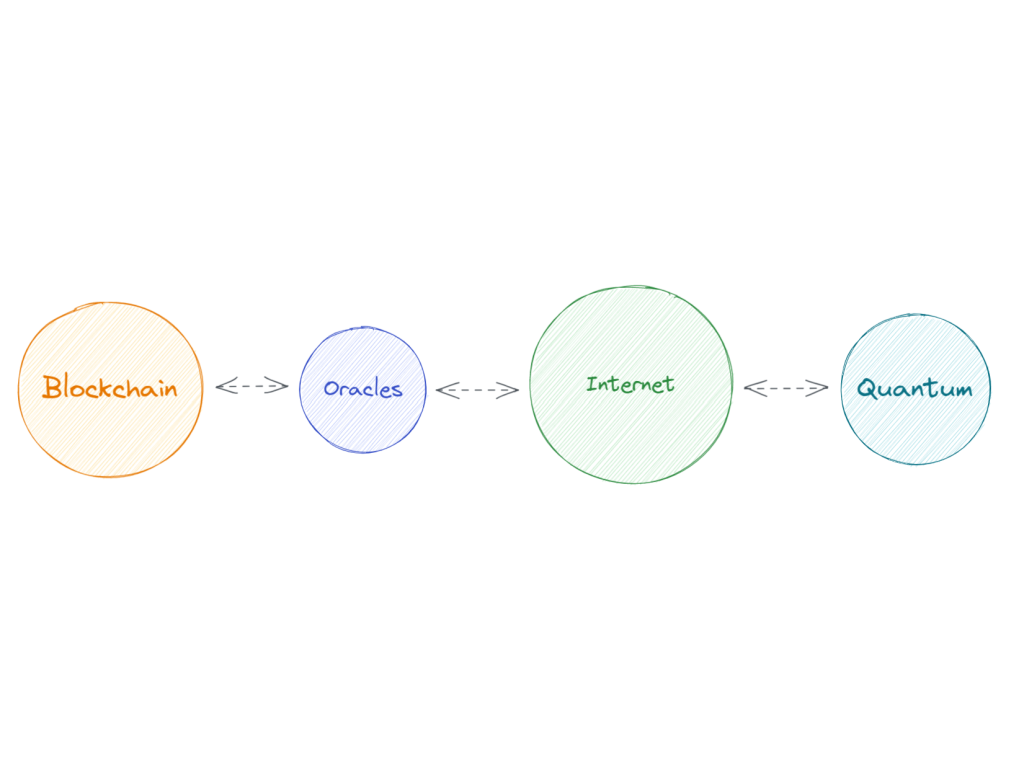
In this article we’re going to go through the requirements, the challenges and the solutions adopted to connect the Ethereum blockchain to the QCentroid Quantum Solutions Platform.

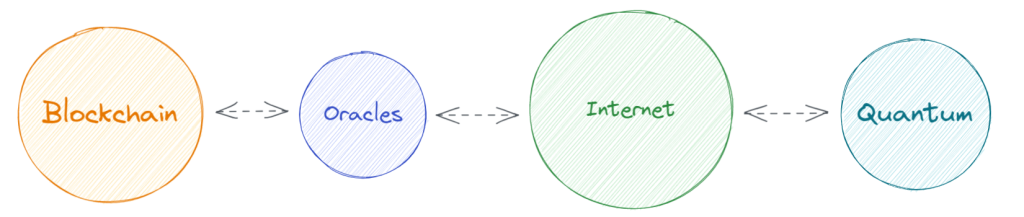
Due to the nature of blockchain ecosystems, accessing off-chain data from on-chain smart contracts is not natively possible. However, oracles like Chainlink provide this bridge between on-chain and off-chain data. Oracles enable smart contracts to retrieve data from the outside world.

Architecture

The QCentroid Platform is accessible through an authenticated REST API, just like almost any other platform out there.

To access our platform from the blockchain, we decided to use ChainLink oracle platform.

Due to the nature of quantum computing, the QCentroid platform works in an asynchronous mode, which means that the result of a computation request is not returned right away in the response. Instead, a Job Id is returned to be used later to check the job status and to obtain the result.

This asynchronous behavior adds a layer of complexity to the whole workflow from the smart contract, through the oracle, to the Quantum Platform and back.

But, before we enter in detail into this workflow, let’s see the architecture that we have deployed and all the components that we need.

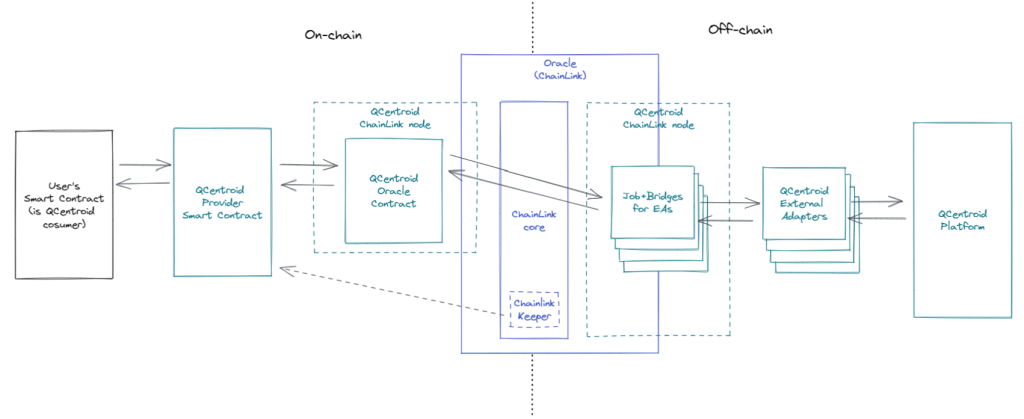
This diagram shows all the components involved:

  • The user’s smart contract
  • The QCentroid Quantum provider smart contract
  • ChainLink Oracle
  • A ChainLink node
  • The External Adapters
  • The QCentroid Platform
  • ChainLink keepers

Depending on your application, you will not always need all these components. In our case, I would like to highlight four of these components and why we decided to deploy, run and operate them ourselves.

The QCentroid provider smart contract simplifies the access to the oracle to the final users. A final user smart contract only needs a call to this provider contract and a callback function  instead of extending the Chainlink client contract and the use of LINK tokens, oracle address and job ids. This provider smart contract manages all this.

If you need to use authentication to access an API you are going to need an External Adapter. This may already exist if you’re accessing a well known API, such as GitHub or Twitter, but if you are trying to connect to your own API or to a not so common API, you’ll have to build your own adapter.

Becoming a ChainLink node operator is not a trivial task, it’s a job itself. In our case, our own ChainLink node is needed to control the access to the Platform API. As the credentials to access the API are managed at the External Adapter, now we need a mechanism to control the access to this external adapter. The way to do this in the ChainLink platform is through address whitelisting at node level. This is why we decided to run and operate our own ChainLink node to be able to manage the list of approved addresses.

ChainLink Keepers provide decentralized and highly reliable smart contract automation. Due to the asynchronous nature of the QCentroid Quantum Platform we make use of ChainLink Keepers to poll the status of the ongoing jobs and fetch the result whenever it is ready.

These four components may or may not be needed by your application, but now you know the role they play in the ecosystem and you can decide whether you need them or not. 

For most of these components you’ll find tons of information and tutorials on how to build and deploy them. Here are the resources that we used at QCentroid to build our ecosystem.

To start building our own External Adapter, we used the Chainlink NodeJS External Adapter Template by Thomas as a starting point. This adapter is written in NodeJS and allows you to run it locally, as a Docker service or serverless (using AWS Lambda for example).
The API-specific values are configured as environment variables, so they are not hardcoded and they can be easily filled by your CI/CD workflow.

Building and running your own ChainLink Node for development purposes is also a relatively simple task relying on the resources shared with us by ChainLink, like the ChainLink SmartContract Kit. There you’ll find step-by-step instructions on how to build and run a ChainLink node. Setting up the node for operational purposes is where things start to get complicated and would be subject for another article. 

Workflow

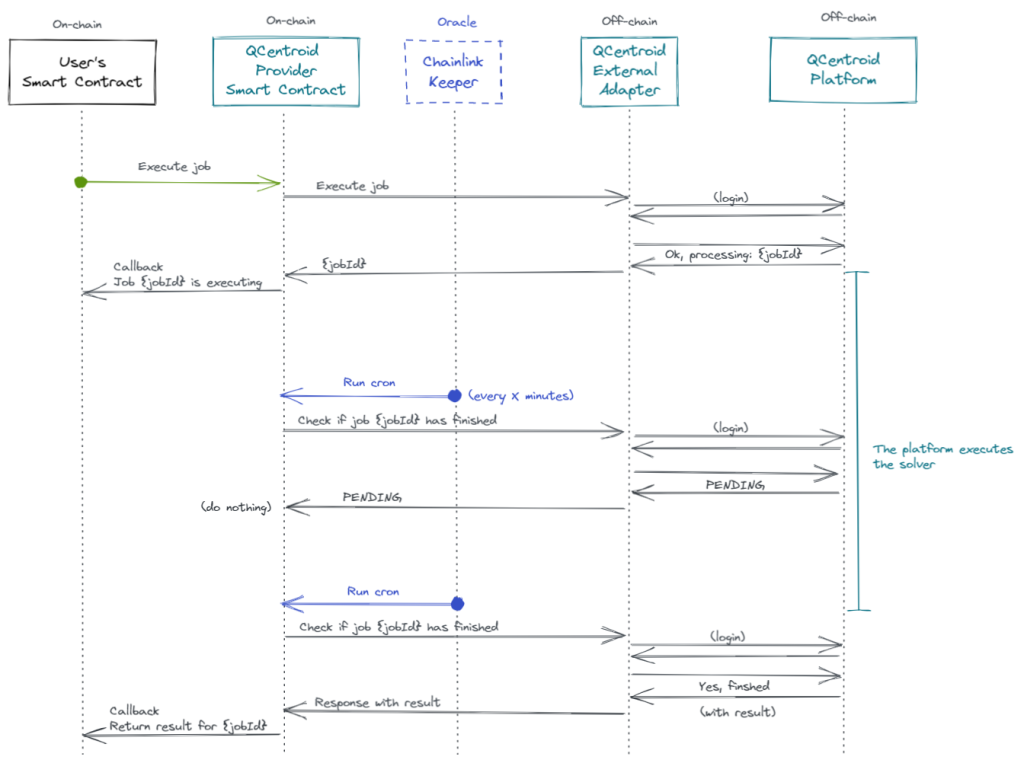
Now that we know what all these elements are, what they are for and how to build and run them, let’s have a look at a full workflow, from the initial request from a user’s smart contract to the reception of the solution from the Platform.

This workflow shows the different components described earlier and how and when they are involved in the process and they’re role.

It’s important to mention that our main objective when designing this architecture was to simplify as much as possible the work needed by our smart contract end users. The diagram clearly shows how few “arrows” are needed on the left and how our users only need to focus on their business. As the workflow moves to the right, we can see how the components involved in the architecture handle the tedious tasks such as authentication or polling for the results.

For our end users, using Quantum computing from a smart contract is as easy as: “here is my data, here is your result”.

With this article, we wanted to show our specific use case of a hybrid on-chain/off-chain architecture and how we’ve approached the connection between these two worlds using ChainLink’s breakthrough oracle technology.

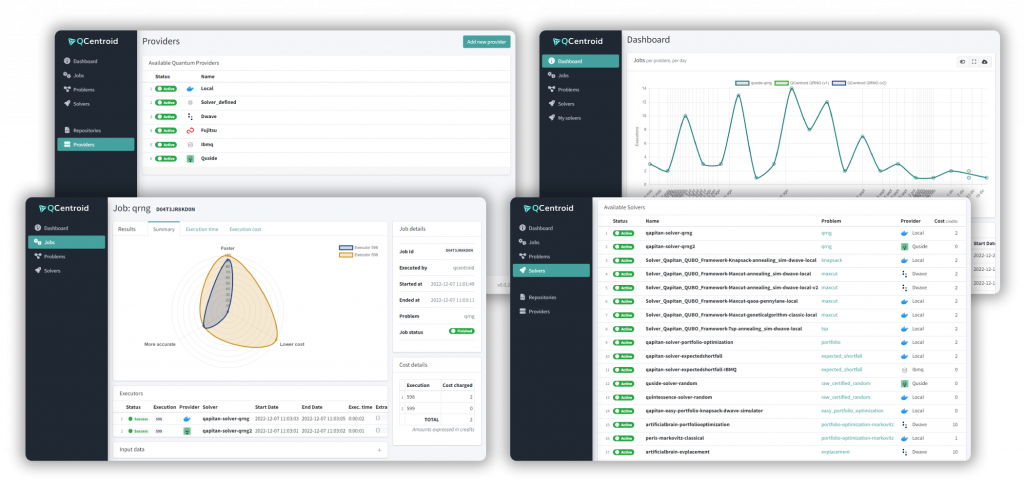
Effortlessly integrate Quantum Hardware, execute Quantum Algorithms, and compare results with our advanced tools.

  • Easily upload and execute quantum algorithms on a wide range of quantum hardware.
  • Seamless integration with existing IT systems through APIs, SDKs and Smart contracts.
  • Comprehensive monitoring and analysis tools to optimize algorithm performance and cost.
  • Pay-as-you-go pricing model for flexibility and cost-effectiveness.